
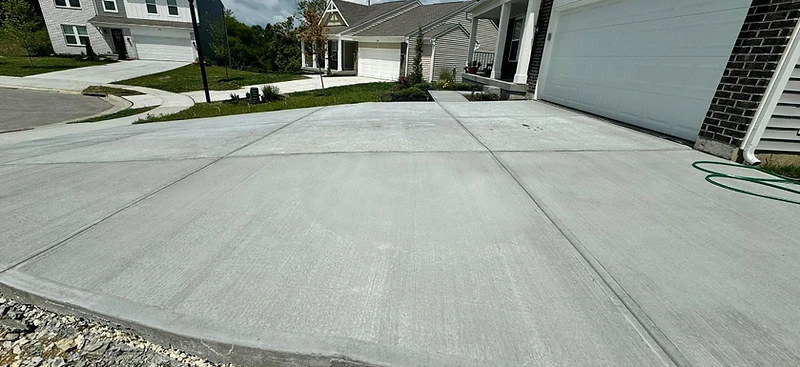
Two slabs, same week, same concrete supplier, same mix. Ten years later one is flat and quiet and the other is cracked and rocking. The difference was never the concrete.
What clay does under a slab
Allen County clay is expansive: it swells wet, shrinks dry, and heaves when the water in it freezes. A slab poured straight onto clay — or onto loose fill sitting on clay — is furniture on a waterbed.
The prep sequence that works
Strip to solid ground. Topsoil is organic and compressible; it all comes out. Old fill is suspect until proven — if it wasn't compacted going in, it comes out too.
Stone, in lifts. A stone base does two jobs: spreads load, and drains water so there's nothing under the slab to freeze. But it only works compacted — placed in layers, each run over with a compactor until it stops moving. Depth depends on the ground we find, and it's itemized on our quotes.
Drainage beyond the slab. Water has to have somewhere to go once it leaves the stone. Grade and drainage planning around the slab is part of prep, not landscaping's problem later.
Then the pour. By pour day, the outcome is mostly decided. Correct thickness, reinforcement, finish and control joints complete the job the base made possible.
Why this is the bid-reading skill
The prep is invisible in every photo and most quotes. Ask any slab bidder: excavation depth, base spec, compaction method, itemized where? Cheap bids go quiet right about there.