
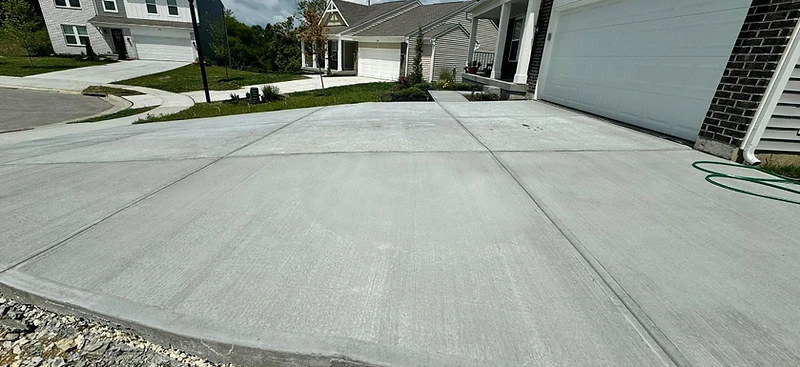
Every photo of finished concrete shows the half of the job that didn't decide anything. The deciding half happened days earlier, below grade, and looked like dirt and stone.
Strip
Topsoil is organic, compressible and temporary — all of it comes out from under any pour. So does old fill that can't prove it was compacted. The excavation stops at undisturbed soil: ground that has carried weight for centuries and will keep doing it.
Grade
Grading is water policy. Where does rain go when it hits this slab, and where does it go after? The subgrade and the finished surface both get pitched so water leaves — away from the house, away from the slab's own base. Flat is not the goal; controlled is. A slab graded wrong works fine every dry day and feeds its own base every wet one.
Base
Stone, placed in lifts, each lift compacted until it stops moving under the machine. The stone does two jobs on clay: spreads load across ground that's stronger than it looks, and drains water so nothing sits under the slab waiting for January. Depth depends on what the excavation finds — which is why it's specified per job, in writing, instead of quoted as a slogan.
Why "compacted base" needs a definition
It's the most-typed and least-performed phrase in concrete bidding. Real compaction is a machine, passes, lifts and a result you can stand on without a footprint. Six inches of stone dumped and driven over once is a stockpile, not a base. Our quotes itemize the base spec so you can hold us to it — and compare every other bid against something concrete.