
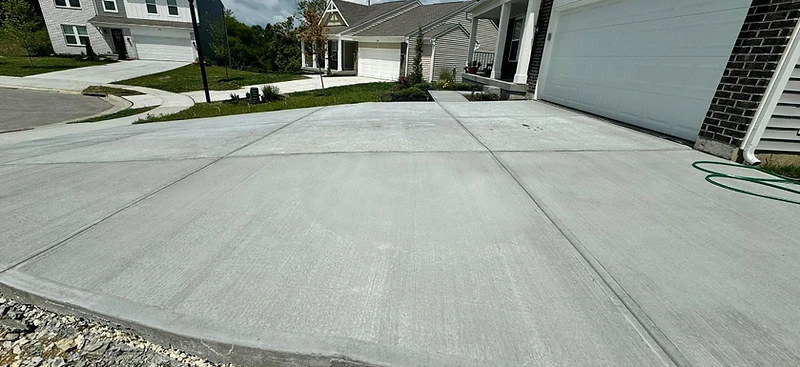
A walkway seems like the simplest concrete on the property. It's also poured right next to the most expensive thing you own — your foundation — which makes its drainage behavior matter far beyond its price tag.
The mistake: the walkway as a dam
A walk poured flat, or tilted toward the house, catches roof and yard water and holds it against the foundation. On clay, that water swells the soil against your basement wall and keeps the walk's own base saturated for freeze-thaw to work on. One bad slope decision, two expensive problems.
The fix: plan water first, path second
Before layout, the question is: where does water move through this yard, and where should it end up? The walk then gets a slight cross-slope shedding water away from the house, and the grade beside it lets that water keep going instead of pooling at the edge.
Layout that works with the yard
Straight runs are cheapest and easiest to shovel. Gentle curves cost a bit more forming but can follow grade more naturally. Either way: width for two people to pass (or one person and a snow shovel), joints spaced to the width, and thickness that doesn't assume nobody will ever roll anything heavy down it.
Steps and stoops
Where a walk meets steps or a stoop, frost depth enters the conversation — a stoop that isn't founded properly heaves independently of the walk and tears the connection apart. It's a small pour that needs structural thinking.
We plan all of this on the walk-through and put it in the itemized quote — slope, base, joints and all.