
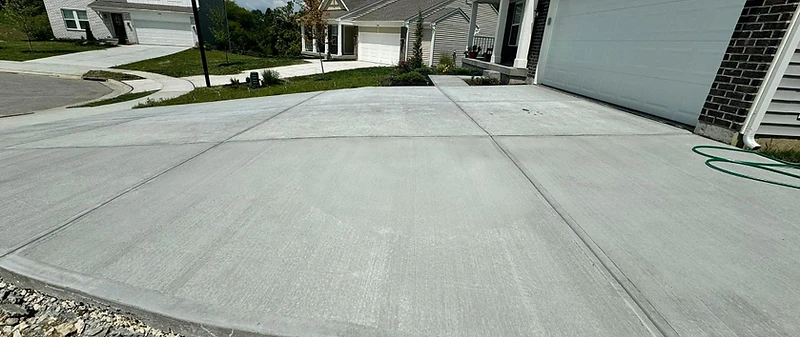
Walk any street in Fort Wayne or New Haven and you'll see the same driveway failures: cracks wandering across slabs, corners heaved up an inch, joints turned into trip hazards. Here's what's actually happening.
The clay problem
Allen County sits on clay. Clay holds water, swells when it's wet, and shrinks when it's dry. Your driveway is riding on ground that changes shape with the weather.
The freeze-thaw problem
Northeast Indiana runs dozens of freeze-thaw cycles every winter. Water trapped in the clay under a slab freezes, expands about nine percent, and lifts the slab. Then it thaws and the slab drops. Repeat forty times a winter for years, and even good concrete gets worked apart.
Why some driveways survive it
The driveways that last aren't poured with magic concrete — the same mix trucks serve everyone. They're poured over a base that drains and doesn't move: excavation down to undisturbed soil, stone placed in layers, each layer compacted until it stops moving. Water drains through stone instead of sitting under the slab waiting to freeze.
Why some don't
Because the base is the easiest place to cut a bid. Skip six inches of excavation, thin the stone, skip compaction passes — nobody can see it on pour day, and the low bid wins the job. The failure shows up in winter three, long after the check cleared.
What to do with this
When you collect bids, ask each contractor to itemize the base: excavation depth, stone depth, compaction method. That one question sorts the bids better than any review site.